
Rule of thumb: if your garage door struggles, jerks, or scrapes at the exact same point every time it opens or closes, the tracks are bent or misaligned. A failing opener or weakening spring usually makes the whole door feel heavy or slow everywhere, not just at one spot on the rail.
The exceptions matter, though. A cable that's jumped off its drum can mimic a bent track by making the door hang crooked. A broken spring can cause someone to force the door up by hand or with the opener, which then bends the track as a secondary problem. And a door that's simply off its rollers on one side can look like a track issue when the track itself is perfectly straight. A technician checks all of this before assuming the rail is the culprit.
Symptoms That Point to a Track Problem
- The door hesitates, jerks, or binds at one specific height on nearly every cycle, rather than being uniformly hard to move.
- Grinding or metal-on-metal scraping as the rollers pass a certain section of track.
- A visible gap between a roller and the track wall, or a roller that looks pinched tight against the rail.
- The door sits crooked when fully open, with one side higher than the other.
- Rollers popping out of the track repeatedly, especially near the curved section at the top.
- The opener reverses the door on its own partway through a cycle, because a bent track has nudged the safety sensors out of alignment.
What a Technician Checks, In Order
1. Impact Damage
This is the first thing checked because it's the most common cause and the easiest to spot. A car bumper, a ladder, a stored bike, or a forklift on a commercial door can knock a track inward or outward in seconds. The dent is often visible to the eye, and it lines up exactly with the spot where the door sticks.
2. Loose Bolts and Brackets
Tracks are held to the framing with lag bolts and brackets, and those connections loosen over time from vibration and thermal cycling. In this climate, wood jambs shrink and shift as they dry out in the heat, which can pull mounting screws just far enough out to let the track flex under load. A technician checks every bracket by hand before assuming the metal itself is bent.
3. Forced Movement From a Different Failure
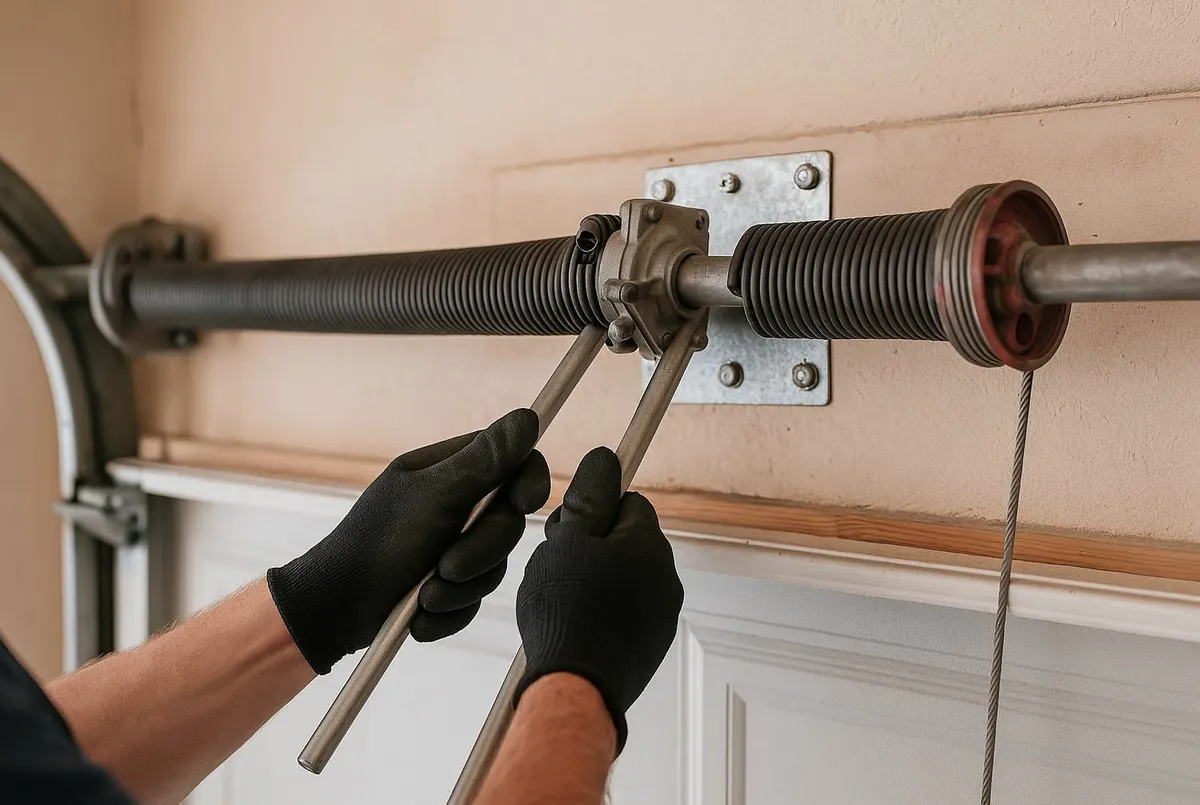
If a spring has snapped or a cable has slipped, the door becomes unbalanced. Running the opener anyway, or lifting the door by hand without knowing the spring is gone, puts uneven pressure on the track and can bow it permanently. This is why a tech checks spring tension and cable position before touching the track adjustment.
4. Rollers and Hinges
Worn or cracked rollers don't travel smoothly, and the extra friction and side-load they create can gradually push a track out of alignment even without a single impact. Nylon rollers that have gone brittle from UV exposure and years of heat are a common culprit, since a stiff or chipped roller fights the track instead of rolling through it.
5. Framing and Wall Movement
Less common but worth checking on older structures: if the garage framing itself has shifted or settled, the track bolted to it moves with it, throwing off the plumb line the door needs to travel straight. A level against the track quickly shows whether this is the issue.
How Each Fix Actually Works
- Minor bends can often be reshaped on site with a mallet and a vise grip, then rechecked with a level.
- Moderate damage usually means replacing just the bent section rather than the whole rail.
- Loose brackets get retightened, re-shimmed, or remounted to solid framing if the original anchor point has failed.
- Severe kinks or repeated roller pop-outs call for full track replacement, and it's common to replace both sides together so the door travels evenly and wears evenly going forward.
- Shifted framing may need the track remounted plumb with new backing added before the alignment will hold.
Worth noting for this climate: monsoon dust mixed with old, heat-degraded lubricant builds up grime inside the track channel that can look and feel exactly like a bend. A thorough cleaning and relube sometimes solves what seemed like a structural problem, which is one more reason a proper inspection comes before any track work.
When to Call Tucson Overhead Door Co
If your door sticks at the same spot, scrapes going up, or hangs crooked when open, it's time for a service call rather than a DIY fix — a bent track under tension can snap back and cause injury. Our Garage Door Repair visits include a full track and roller inspection, and if we find a related spring or cable issue, our Spring Replacement service handles that safely at the same time. We serve Tucson, Marana, Oro Valley, Catalina, Casas Adobes, Flowing Wells, Sahuarita, and Green Valley. Call Tucson Overhead Door Co today and get your track checked before a small bend turns into a door that won't move at all.